Categories
Hockey

Is the Stop Sign Jersey Patch Working?

In rinks across the country, a small red stop sign stitched to the backs of minor hockey players’ jerseys has become a familiar sight, but it is too often ignored.

Introduced as a safety reminder in the early 2000s, the patch aims to reduce dangerous hits from behind. Now, more than two decades later, hockey parents, coaches and officials are asking: Is it actually working?

“We see fewer hits from behind than we used to, but they still happen,” said Dave MacIntyre, a longtime referee supervisor in the Greater Toronto Hockey League. “The stop sign helps with awareness, but it’s not a solution on its own.”

The patch, which is mandated by many minor hockey associations across Canada, is positioned between a player’s shoulder blades. Its goal is simple: when you see the sign, you stop. But enforcement remains inconsistent, and critics say the culture of aggression in youth hockey can undermine its purpose.

A recent study examining Hockey Canada’s “zero tolerance for head contact” policy found no significant decrease in head contact incidents post-implementation suggesting that policy changes and visual cues alone don’t always translate into safer play.

Meanwhile, localized reports from leagues using the STOP patch have shown up to a 10 to 20 per cent decrease in hits from behind since its introduction.

“Too many kids still go into the boards head-first,” said Shane Watson, a coach with the Oshawa Minor Generals. “The patch is great in theory, but it needs to be part of a bigger conversation around respect and discipline.”

Is the stop patch working in minor hockey?

Some parents are skeptical about its effectiveness.

“My son plays AA,” said Shelly Wright, a Whitby hockey mom. “He’s been cross-checked into the boards with the stop sign right there. If a kid’s not been taught properly, that patch won’t change much.”

Hockey Canada says it continues to promote education and awareness around safe contact and proper checking techniques. Officials at all levels are trained to enforce Rule 7.6, which prohibits checking from behind and carries automatic penalties, including game misconducts.

But MacIntyre said the issue isn’t just rule enforcement, it’s repetition.

“Players need to hear it every single week: don’t hit from behind. They need to hear it from coaches, parents, refs, not just see it on a jersey,” he said.

Some associations are going beyond the patch, implementing mandatory safe checking clinics, respect-in-sport courses for parents, and supplemental discipline systems.

In Windsor, Ont., where the STOP program first launched in 1995, local associations report positive changes in player behaviour over time. Coaches say players are more likely to think twice before finishing a hit when they see the sign especially at the younger levels.

“There’s a real opportunity when they’re still learning,” said Jason Cooper, a house league convenor in the Windsor Minor Hockey Association. “If you teach them early, they carry that forward. But if you wait too long, the habits are already there.”

For some, the stop sign is a necessary but incomplete solution, a single tool in a much larger toolbox. 

As minor hockey continues to evolve, experts believe the stop sign remains a useful tool but only when backed by consistent coaching, strong officiating and a collective commitment to player safety.

The post Is the Stop Sign Jersey Patch Working? appeared first on Elite Level Hockey.

Categories
Hockey

THE NEW PATH: How Are Other Leagues Affected?

You might think that Tier II junior leagues and U Sports teams would be devastated by the decision allowing CHL players to now play NCAA hockey.

That’s not how it is at all. At least it’s not what the two groups are saying for public consumption.

“This decision puts the development of the athlete at the forefront, and we are enthusiastic about the bright future it holds for players in our province,” said Marty Savoy, Commissioner of the Ontario Junior Hockey League.

Prior to the Nov. 7, 2024 ruling by the NCAA that CHL players would be eligible going forward to play college hockey in the USA, Tier II junior leagues like the OJHL, Alberta Junior Hockey League, Saskatchewan Junior Hockey League and BCHL were the main options in Canada for young Canadian players seeking to maintain their US college eligibility.

Once those shackles were removed, there was instant upward movement of players within all of these leagues jumping to the CHL.

From the BCHL alone, there were 37 players making the move into the CHL. Surrey Eagles coach and former NHL player Scott Gomez acknowledged that the hockey development landscape has been forever altered by this NCAA ruling.

“The path and the pipeline is going to change as to how you get (to the NCAA),” Gomez told Black Press Media.

Still, those in charge of these Tier II junior leagues are of the opinion that what leads to the betterment of young players is also better for them. After all, they are in the business of developing hockey talent.

“This is good for players because now you’re not going to force players to make decisions when they’re young and not informed and they’re not pressured to make certain choices that are going to impact their future,” SJHL Commissioner, Kyle McIntyre said. “It puts the players first.”

Another concern for the Tier II leagues may be the loss of franchises. Two BCHL teams are heading to the WHL. The Penticton Vees will be given an expansion franchise in 2025-26, with the Chilliwack Chiefs slated to make the move in 2026-27.

U Sports Recruiting Will Be Altered

In past years, CHL players who didn’t earn pro contracts would often wind up playing U Sports hockey at one of Canada’s universities. However, a number of those players who would traditionally follow that route are now instead heading south of the border on US college hockey scholarships.

“I know it’s going to affect my recruiting 100 percent,” Queen’s University coach Brett Gibson told Sportsnet. “I know it’s going to affect the landscape of U Sports. But we just don’t know to what extent it’s going to affect it.

“I’m a firm believer that I think the NCAA is holding the cards right now and I’m just playing with them. That’s the hard part.”

Playing a significant role in encouraging CHL players to go the U Sports route in the past was the CHL Scholarship And Development Agreement. Under the standard CHL Player Agreement, a player gets credited with one year of post secondary tuition, books and fees paid for each year they play in the CHL. The amount is based upon the costs to attend the university closest to their home.

With the change that now enables players to go from CHL teams to play NCAA hockey, the money the player has earned from the CHL Scholarship And Development Agreement can be utilized to cover any costs they incur while playing college hockey in the US.

Recognizing that the landscape is changing, Toronto Metropolitan University (TMU) Bold assistant coach Michael Fine arranged a game last January between the Bold and the OJHL 20’s selects team. The Bold were 2-0 winners, opening the eyes of the OJHL players to the quality of play in U Sports hockey.

The session also included a seminar explaining to the players the advantages of choosing the U Sports path.

“It’s going to be human nature that those (NCAA) D1 teams look to the CHL guys first, just because of how they look at the league,” Fine told theeyepener.com. “OJHL guys might start having to look at U Sports a bit earlier.”

Gardiner MacDougall, who coached the University of New Brunswick (UNB) Reds to five U Cup championships before moving to the QMJHL’s Moncton Wildcats, is confident that U Sports hockey will be fine in the long run.

“U Sports is still going to find their players, just maybe initially not the pedigree that they normally would have,” MacDougall said.

Elite Level Hockey

SHARE YOUR MINOR HOCKEY JOURNEY!

The post THE NEW PATH: How Are Other Leagues Affected? appeared first on Elite Level Hockey.

Categories
Hockey

THE NEW PATH: Will the Rule Change Hurt the CHL?

The rule change allowing CHL players to play NCAA hockey is certainly a wonderful development for those players. But is it a good thing for the CHL itself?

The answer to that question is both yes and no.

The rule change permitting CHL players to continue on to play NCAA hockey is enabling a number of top prospects who’d otherwise be required to give the three CHL leagues — the OHL, QMJHL and WHL — a pass, the opportunity to play in what’s considered the top developmental league in North American amateur hockey.

It’s certainly taking the pressure off of kids who were being forced at the age of 15 or 16 to make a major decision on the future path for their elite hockey development. Prior to this rule change, anyone playing even one game in the CHL was immediately declared ineligible for NCAA hockey.

“For many years, parents and players who were 15 years old had to make a decision on their academic careers at a really young age and were not allowed to play in the CHL, which is the best development league in the world, while they’re waiting to go to college,” CHL president Dan MacKenzie told Canadian Press. “And so now that pathway is going to converge, and they’re not going to have to worry about that.”

Even those people on the college side of the equation are of the opinion that ultimately, this is opening up all the doors of opportunity for young players, and that’s going to be for the betterment of all leagues.

“I think for the fairness of everybody, it’s the right decision,” former NHLer player and Wisconsin coach Tony Granato told Sportsnet. “You can go play in the (CHL), just like you play in the USHL, and you should be able to go to college.

“I think that’s the way it should be. At the end of day, if you’re looking to have hockey grow and make it better, I think this is an opportunity to look at it that way, and I think that’s what’s going to happen.”

Players Moving In Both Directions

Dozens of CHL players were quick to take advantage of the opportunity to grab an NCAA scholarship from the moment it became a reality in November of 2024. It’s giving several of them a chance to extend their hockey careers and to get a post-secondary education while still pursuing the possibility of a career in pro hockey.

Windsor Spitfires overage forward Ryan Abraham, 21, recently accepted a scholarship offer from the Northern Michigan Huskies.

“I never thought I would get the chance to play college hockey,” Abraham told the Windsor Star. “Now, I get to extend my career playing it.”

It’s especially prevalent for goalies. Most netminders tend to be late bloomers when it comes to development. You won’t often find a regular NHL goalie under the age of 25. By being able to take the college route following their junior days, it gives these netminders more time to refine their skills.

For instance, Andrew Oke, who backstopped the Saginaw Spirit to the 2023-24 Memorial Cup title, is committed to play at Lake Superior State next season.

Top Players Moving To CHL

At the same time, players who weren’t previously able to play in the CHL made the jump to those leagues once they knew it wouldn’t preclude their NCAA opportunity. Goaltender Rudy Guimond left Cedar Rapids of the USHL to join the QMJHL Moncton Wildcats. Playing for the CHL’s top-ranked team, Guimond went 16-0 during the regular season with a 1.73 GAA and .940 save percentage, along with three shutouts.

“When it opened up, Moncton is the best team in the country,” Guimond said. “I was like, ‘I gotta go there.’”

What If Top Stars Leave?

One concern for the CHL is that there’s always the chance that top CHL stars might look to move to the NCAA.

There’s been speculation that the Michigan Wolverines are pursuing two of the best current CHL players, Porter Martone of the Brampton Steelheads and 16-year-old WHL phenom Gavin McKenna of the Medicine Hat Tigers.

Meanwhile, the Boston Terriers are reportedly after Michael Misa of the Spirit. However, both Misa and Martone are expected to be high first-round picks in the NHL entry draft and could be jumping directly into the show next fall.

MacKenzie, though, is of the belief that the opposite will be happening and that the CHL will become the place top prospects are choosing first.

“We think the best players in the world — 16, 17, 18, 19 year olds — are going to want to play in the CHL,” MacKenzie said. “So we see the talent level of our league increasing and increasing pretty dramatically and being a real destination for players.”

MORE STORIES ON EDUCATION AND SCOUTING …

Elite Level Hockey

SHARE YOUR MINOR HOCKEY JOURNEY!

The post THE NEW PATH: Will the Rule Change Hurt the CHL? appeared first on Elite Level Hockey.

Categories
Hockey

How Much Does Hockey Cost?

Hockey is becoming increasingly inaccessible to many Canadian families as the costs of playing continues to rise with increases in registration fees, equipment prices and ice-time rates.

What was once a neighbourhood pastime played on frozen ponds has transformed into a billion-dollar industry with competitive youth leagues, specialized coaching, and elite training programs creating new barriers for entry.

According to a 2023 survey by Hockey Canada, the average annual cost to play minor hockey at the competitive level surpassed $5,000 per player, with some families paying upwards of $10,000.

House league participation costs are lower, but they’ve also crept upward, averaging between $800 and $1,200 per season not including travel and gear.

“I’ve seen a big difference over the past decade,” said Lindsay Cote, a mother of two boys playing minor hockey in the Greater Toronto Area. “When my eldest started, it was pricey, but manageable. Now with tournaments, extra ice time, and new equipment every year, it’s honestly overwhelming.”

Much of the rising cost is attributed to the growing privatization of the game. Many players now take part in offseason development camps, private skills sessions, and spring leagues that promise higher performance and improved chances of being scouted at a premium price.

Ice time itself has also become a major financial hurdle. Municipalities across the country are charging more to rent rinks, while older arenas are being shut down due to lack of funding, reducing access in some communities.

Hockey gear is another growing expense. A new set of mid-range equipment can easily run between $600 and $1,000. For fast-growing children, that often means replacing skates, pads, and sticks nearly every year.

Some organizations are working to make the sport more affordable. The NHL and NHLPA’s “First Shift” program offers introductory hockey packages, including gear and instruction, for $299.

Other local initiatives like used equipment drives and subsidy programs aim to lower entry barriers.

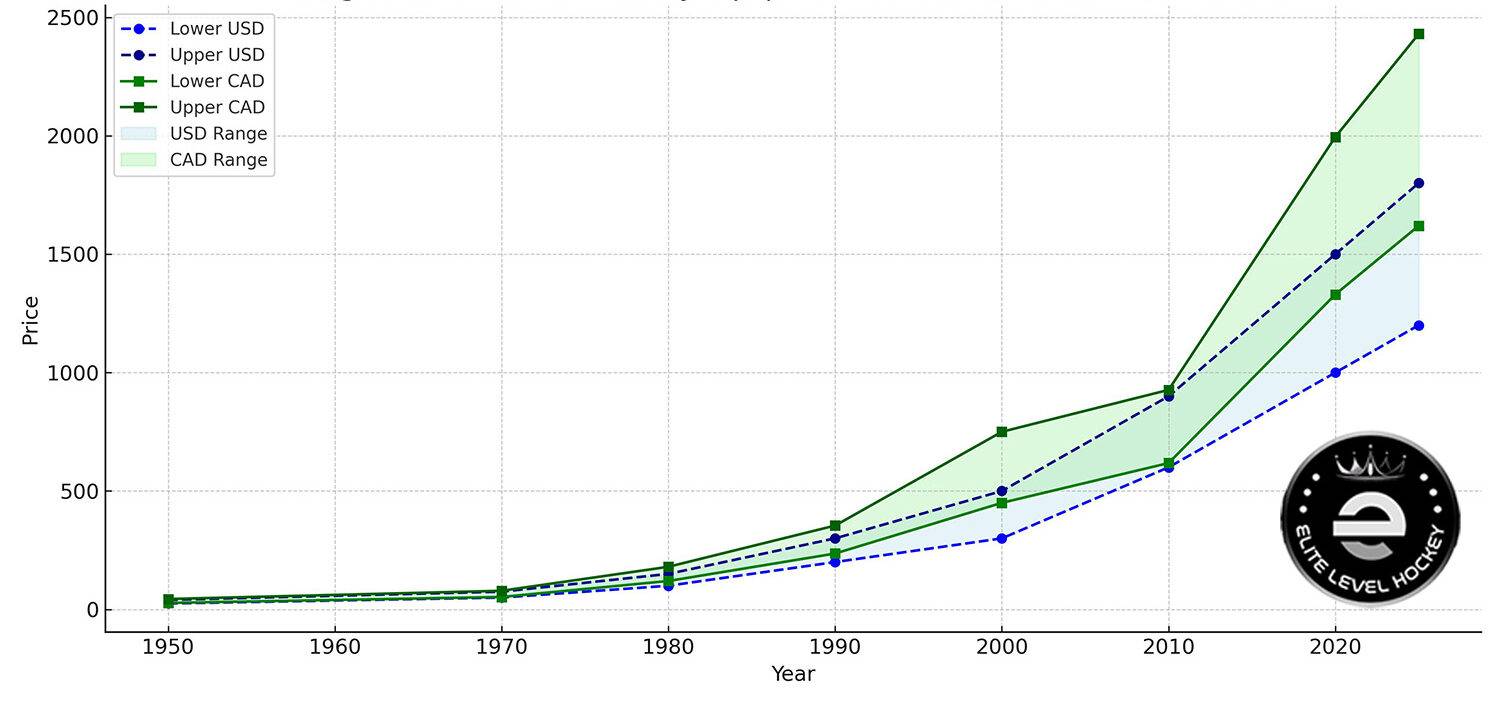
The Average Cost of Hockey Equipment from 1950 to 2025

Cost of Hockey Equipment Graphic

Travel has become one of the most unpredictable and costly aspects of the game. Weekend tournaments often require hotel stays, gas, and meals for entire families, with some elite teams flying out of province or even internationally for showcases. In some cases, annual travel-related expenses alone can run into the thousands, especially for families with multiple children in the sport.

Still, many worry the sport is becoming increasingly elitist.

Hockey gear is another growing concern. A full set of mid-range equipment including skates, helmet, shoulder pads, gloves, pants, and sticks can easily exceed $1,000.

“We’re seeing more parents come in with sticker shock,” said Mike Tran, assistant manager at a Toronto-based hockey supply store. “A good pair of junior skates can cost $300 to $600 now. And with how fast kids grow, they might need a new pair next season.”

At Pro Edge Sports in Mississauga, owner Sarah Dupuis says customers are becoming more cautious.

“People are asking more questions, looking for used gear, or sticking to last year’s models. We used to sell top-of-the-line sticks to 10-year-olds now, people are second-guessing that,” Dupuis said. “It’s not just about performance anymore. It’s about making the season financially possible.”

“The dream of playing hockey should be for everyone,” said Cote. “But for more and more families, it’s just not realistic anymore.”

As the cost of hockey continues to climb, parents, retailers, and advocates are calling for change whether through greater funding for community programs, affordable gear.

Many agree on one thing: If the sport is to remain accessible at all levels, the price of playing needs to come down.

The post How Much Does Hockey Cost? appeared first on Elite Level Hockey.

Categories
Hockey

THE NEW PATH: CHL and NCAA Scholarships

For decades there were two paths that an elite-level teenaged hockey player could follow. They could play in one of the CHL’s three leagues — the OHL, QMJHL, or WHL. Or they could play NCAA hockey.

While it was possible to go play in the NCAA and then change your mind and join a CHL team, the other option wasn’t available. Under NCAA rules of the day, once a player played a game in the CHL, they were instantly ineligible for NCAA hockey.

The reasoning was because there were players in the CHL under NHL contracts. In the eyes of the NCAA, that made them pros, and any player who played a sport against pros was ineligible to play that sport in the US college ranks.

This put immense pressure on young, talented hockey players. Drafted into the CHL at the age of 16, they were being forced at a very young age to make a life and hockey-altering choice. If they took the CHL path, they were forever closing the door to the opportunity to earn a US college hockey scholarship.

However, the times, they are a changin’. On Nov. 7, 2024, a seismic shift in the way developmental hockey works was undertaken. The NCAA announced that CHL players would now be eligible for NCAA hockey scholarships.

Opening a route that created the path to this change was the introduction in US college sports of the NIL (Naming, Image, Likeness) ruling in June of 2021. With this new initiative, the NCAA was now allowing student-athletes to make money from their personal brand. If they were getting paid, it only made sense that players playing in leagues where some players were getting paid would no longer be an obstacle to participating in NCAA hockey.

The NCAA first proposed this change in policy in August of 2024. The NCAA’s ruling followed a class-action lawsuit filed Aug. 13, 2024 in U.S. District Court in Buffalo, New York, challenging the NCAA ban on CHL players. The lawsuit was filed on behalf of Riley Masterson. The player from Fort Erie. Ont. lost his college eligibility in 2022 after appearing in two exhibition games for the OHL’s Windsor Spitfires at the age of 16.

“It’s long overdue, but this is a great result,” Stephen Lagos, one of the attorneys who filed the lawsuit, wrote in an email to Associated Press. “We’re looking forward to players and fans seeing the benefits of a more competitive and fair market, without the rule.”

Both Sides Felt It Was Time For Change

Not only was there little resistance to this change in approach for top-level amateur hockey, it was in fact a movement that was embraced by all stakeholders in the industry.

“Everyone expected the rule to change,” Central Collegiate Hockey Association Commissioner Don Lucia said. “In time, it will prove to be a positive change for all involved.”

Likewise, major junior officials were also embracing the change. The CHL released a statement emphasizing the fact that the rule change would be opening up more opportunity to play high level developmental hockey for a longer period of time to young players.

“We believe this is a positive development that will provide our players with more opportunities to continue their hockey and academic careers following their time in the CHL,” the CHL noted in a statement. “It will also give young players and their families more options in choosing their development path.”

CHL Players Quick To Embrace New Opportunity

It didn’t take long for CHL players to be jumping at the chance to accept an NCAA scholarship. Braxton Whitehead, a center with the WHL’s Regina Pats, was the first player to do so, making a commitment to the Arizona State Sun Devils.

So far, 26 OHL players have embraced this new opportunity, accepting NCAA scholarship offers for the 2025-26 season.

“Before it was OHL or NCAA,” Kitchener Rangers goalie Justin Parsons told TheRecord.com. “You had to pick one.”

He accepted a scholarship offer from the Clarkson Golden Knights.

“Now, being able to do both is unbelievable,” Parsons said. “I’m so proud to be a Golden Knight.

“I actually toured the campus with my minor midget team in Grade 10. I went and watched a game. It was an unbelievable atmosphere.”

Elite Level Hockey

SHARE YOUR MINOR HOCKEY JOURNEY!

The post THE NEW PATH: CHL and NCAA Scholarships appeared first on Elite Level Hockey.

Categories
News Press Release

Introducing…Forums by Travelsports

FOR IMMEDIATE RELEASE
April 2025                                                                       

Contact: Chris Pauly

Introducing…Forums by Travelsports
Launch of Online Engagement Platform Marks Latest
Step in Company’s Mission to ‘Connect, Inform, Inspire’

CHICAGO, IL—Travelsports.com today announces the launch of its new Forums by Travelsports feature that builds on the website’s standing as the ‘go-to’ destination for athletes and families seeking information and insights on the $42 billion North American travel sports market.

Your Invitation to Connect, Inform, Inspire
Forums will allow participants to engage directly with others involved in youth and adult sports throughout the United States, Canada, and Europe – all while having access to the vast trove of information assembled and curated by Travelsports.

With more than 160,000 tournament, club, and facility listings for sports ranging from hockey and baseball to basketball and volleyball, Travelsports helps users:

  • Identify training facilities,
  • Research tournaments,
  • Contact coaches,
  • Locate area sports clubs,
  • Plan travel itineraries (research lodging, restaurants, and entertainment options in destination cities),
  • Leverage fundraising opportunities to support their club or team,
  • And more.

A Better Way to Engage
Forums lets users join conversations that matter most to them – any topic at any time.  Comment on existing forums or create your own.  It’s an opportunity to share experiences and insights with others on an open platform.

There are no private groups to join; no pages to follow; no more “siloing” of discussions by specific sport; no more echo chamber discussions with few, if any participants.

“As parents of two kids who play organized sports, my wife and I were frustrated by how difficult it was to find useful information and connect with other families to compare notes, ask questions, and share ideas,” explained Travelsports.com founder Christopher Pauly.

Forums by Travelsports establishes a new online discussion eco-system: one that opens doors, expands horizons, and enhances opportunities for people to engage with others on practically any topic and make the most of their sports experiences,” he added.

Encouraging open discussion of sports-related topics leads to the sharing of some interesting subjects.  Examples of topics currently trending on Forums include:

  • “Team friendly restaurants in Ann Arbor, Michigan”
  • “Best Hockey Movies”
  • “Totally Random Review on Baseball Bats”
  • “Recommendations for Bigger Car for Carpool and Hockey and Lacrosse Equipment”

Visit Forums by Travelsports at https://travelsports.com/forum to join the conversation.

About Travelsports.com

Travelsports is the leading provider of information for the youth and adult sports industry. We strive to connect, inform, and inspire the sports community by providing a one-stop destination for tournaments, clubs, facilities, insights, and resources.  Our goal is to support the success and well-being of individual athletes and the vibrant sports ecosystem.

At-a-Glance: Travelsports.com

  • Launched in 2020
  • Millions of page views (2024)
  • Largest listing of tournaments, clubs, and facilities (160,000+ globally)
  • Primary focus on U.S., Canada, and Europe

###

Categories
Hockey

The Evolution of the Hockey Stick

Whether it’s a booming slapshot from the point or a slick deke on a breakaway, the hockey stick is at the heart of the game and its construction is more complex than it may seem.

Modern hockey organizations, from NHL teams to junior clubs, often rely on partnerships with major stick manufacturers like CCM, Bauer and TRUE Hockey. These companies produce customized sticks designed to match each player’s unique preferences from flex and kick point to blade curve and grip texture.

“Each stick is basically an extension of the player’s body,” said Craig Desjardins, vice-president of product innovation at Bauer Hockey. “The wrong stick can throw off everything, shot accuracy, release time, even comfort on the ice.”

While wooden sticks still have a nostalgic place in hockey history, they’ve largely been replaced by composite models. Most sticks today are made from layers of carbon fibre and resin, built for strength, flexibility and lightness.

The process starts with sheets of carbon fibre laid in specific patterns to control flex. These sheets are wrapped around a mould, forming the shaft, before being combined with the blade and cured in a high-temperature oven. Bauer applies its signature finishes: tactile grips, blade textures, and graphics that vary by model and player preference.

“Depending on the stick’s flex rating, we’ll adjust how many layers of carbon go into the shaft and how tightly they’re woven,” said Riaz Miller, an employee at Bauer Hockey. “That controls the energy transfer during a shot.”

The Stickmaking Process

Step 1

Creating the shaft with sheets of carbon fibre. These sheets are wrapped around a mould, forming the shaft.

Step 2

Building the blade the shape of the blade is wrapped in layers of carbon fiber. Then placed into a two-part mold.

Step 3

Assembling the Shaft and Blade the hardened shaft and blade are bonded together using glue then smoothing the edges.

Step 4

Painting and Graphics the stick is painted, and logos are added.

A clear coat is applied to protect the graphics and surface.

Step 5

The sticks get a grip coating or textured surface on the shaft.

Step 6

A final inspection ensures the sticks meet quality standards before getting shipped.

After curing, each stick is cut to size, painted, and finished with details like grip coating and decals. For professionals, the customization goes even further.

While NHL stars like Connor Bedard and Auston Matthews use highly customized Bauer sticks, the same technology is available to young players and weekend warriors.

“When a player like Matthews wants a certain flex profile or blade stiffness, we build that to spec,” said Miller. “But then we take that feedback and apply it to our retail sticks so that players everywhere can benefit from elite-level performance.”

Bauer also offers MyBauer a custom program that lets amateur players personalize everything from blade curve to flex to grip finish.

“Players are more educated than ever,” Miller added. “They know what they like, and we’re giving them the tools to build their perfect stick.”

Bauer tests the durability and performance of its sticks under extreme conditions, using advanced materials like boron fibre and a range of lab simulations. “We put our sticks through rigorous testing using specialized machines,” said Desjardins. “Then we validate that with real-world performance data from professional players.”

The company also monitors specific metrics, such as flex ratings, a number that indicates how much weight is needed to bend a stick one inch from its neutral position. “Understanding flex helps us matchsticks to playing styles and physical strength,” he said.

To keep sticks in top shape, Bauer recommends players take care of them off the ice too. “Store your stick in a cool, dry place to prevent warping or damage,” Desjardins advised. “Keep it clean, dry, and replace the tape regularly. Avoid leaving it in direct sunlight or near heat sources.”

As the pace of the game continues to rise, several manufacturers remain committed to crafting the perfect stick, one flex point, one curve, and one goal at a time.

The post The Evolution of the Hockey Stick appeared first on Elite Level Hockey.

Categories
Hockey

Canadian Blind Hockey Association is changing the game

Walking into the arena, it feels like any other hockey game — cold air, the sound of skates on fresh ice, the anticipation building in the stands. But as the puck drops, something unique happens.

Instead of the sharp clack of a traditional puck, the game opens with a rattling clang-clang, a hollow metallic sound that echoes through the rink.

The Canadian Blind Hockey Association (CBHA) is changing the game for athletes who are blind or partially sighted, offering a chance to play Canada’s sport in an inclusive competitive environment.

”Blind hockey is about more than just the game  It’s about the community confidence and breaking barriers. We’re creating opportunities for players of all skill levels to experience the sport in a way that suits their ability.” said Matt Morrow, executive director of the CBHA.

Founded to promote and develop blind hockey across the country, the CBHA runs a variety of programs, from introductory “Try Blind Hockey” sessions to the Canadian National Blind Hockey Tournament, which has grown to be the largest event of its kind. In 2025, a record 190 players participated across seven divisions.

Hockey for the blind continues to grow

Blind hockey is adapted for athletes with varying degrees of vision loss, from approximately 10% vision to complete blindness. The sport utilizes an adapted puck that is larger than a standard puck and emits noise, allowing players to track its movement.

“The sound of the puck rattling down the ice, it becomes our heartbeat. It’s not just a noise, it’s direction, it’s energy, and it tells every player you’re in the game.” said Mel Carrey, the marketing manager at CBHA.

To maintain fairness, teams must have at least one completely blind player on the ice at all times. Goalies are required to be fully blind or have minimal vision, and passing rules ensure that players rely on teamwork rather than individual breakaways. Nets are slightly smaller than those in traditional hockey, and officials blow a whistle to signal when the puck is in the offensive zone to help orient players.

The CBHA has expanded programming nationwide, with regional teams in cities such as Ottawa, Vancouver, and Montreal.

“We’re growing, and that means more people have the chance to get on the ice,” said program director Luca DeMontis. “It’s inspiring to see how much this sport means to players and their families.”

The organization has also partnered with groups like Accessible Media Inc. (AMI) and The CNIB Foundation to support its initiatives. “We’re proving that vision loss isn’t a barrier to playing the sport we love.” DeMontis said.

The CBHA’s efforts extend beyond the rink. The organization works with schools, community groups, and rehabilitation programs to raise awareness about blind hockey and its benefits.

“ Blind hockey isn’t just about playing a sport. It’s about changing perceptions of what people with vision loss can achieve. Our players are role models showing young athletes that anything is possible.” Morrow said.

The association is also working to expand its youth and development programs, encouraging children with vision loss to take up the sport at a young age.

“The earlier they start, the more confident they become in their abilities—not just in hockey, but in life,” DeMontis added.

As the CBHA continues to grow, they hope to keep expanding the game and improving player development, and ensuring that blind and partially sighted individuals have the opportunity to experience the game.

“ We’ve seen incredible growth in the last few years, from small community rinks to national tournaments. Every new city we launch a program means more kids discovering that they can be long on ice.” Carrey said.

With its commitment to accessibility and inclusion, the CBHA continues to make hockey a game for all, ensuring that every athlete regardless of vision can hear the puck, feel the ice and experience the thrill of the game.

The post Canadian Blind Hockey Association is changing the game appeared first on Elite Level Hockey.

Categories
Hockey

Saying goodbye to minor hockey

I’m waiting in the Durham West Lightning U18A dressing room for the young ladies to arrive.

The room is decorated with banners, balloons, and tinsel curtains. Jerseys are displayed around the room with hand-made posters of each player hanging above them.

It’s Senior’s Night. 

In this moment of solitude, I take in the decor, which represents the end of their hockey careers and, for many, their childhood.

Every spring, across Canada, players turning 18 hang up their skates and graduate from the minor levels of the sport. While a few may continue playing at the university or professional level, most will either join an adult recreational league or never play again.

They are moving on to post-secondary education and the next chapter of their lives. 

For most of the girls and their parents, this marks a major lifestyle change. For the past 14 years, their love of the sport has meant spending much of their family time at the rink.

They’ve driven to early morning practices, raced from school to the rink while eating dinner in the car, and spent weekends at tournaments both locally and across Canada and the United States.

Some have even traveled to Europe for tournaments.

Some players have always played together.

Some have played on teams all across the region. Whether on the same team or as opponents, these girls have been playing hockey together for years.

Through all that time spent together, these players and their parents have formed strong bonds — they’ve become a family. 

This year, they all somehow ended up together for their final season which included a few wins, a few silver medals and an epic trip to Nashville. The team has a large graduating class.

Ten players will be moving on, meaning with over half of the players leaving, the team will look very different next season. It’s now up to the younger players to take the lead, and they’re ready for the challenge. 

Earlier, the minor players (Amanda, Ella, Kara, Kennedy, Nyah and Sara) prepared the celebration.

As they decorated the dressing room, the atmosphere was a mix of giggles as they struggled to control over-inflated balloons and emotional moments as they looked at old photos from their early hockey days. “Skyley was so cute,” said Mia, wiping away a tear.

Some of the others gathered around her, gazing at the banner of their team captain. Then one of them glanced at the clock and realized the seniors would be arriving soon.

They quickly got to work, coordinating their efforts like they do on the ice. Once the room was ready, they briefly admired their work before being shooed out by Christina, the team manager. 

When the seniors entered the room with their parents, I was reminded of the museum exhibit scene from the end of movie A League of Their Own, where the families take in the moment, absorbing its significance.

There was a brief silence as they reflected, and then the tears began to flow, followed by hugs. Soon, the parents joined in. I felt deeply honored to witness such a special moment. I watched as the players recalled memories.

They teased each other over the baby-faced photos of little girls in too-big jerseys and sagging socks taped tightly to keep them up.  

Dads who suddenly realized that the ride was coming to an end awkwardly joked about all the money they would save, and moms spoke of being able to make vacation plans that don’t revolve around hockey.

A thin disguise hiding how much they were going to miss their hockey parent days.

A few minutes later, the younger players — the minors — entered the room, also becoming emotional. While it wasn’t their day, they knew they would miss their hockey sisters and role models.

It was also a reminder that their own day to hang up their skates was approaching all too quickly. 

It wasn’t long before Kaleigh, one of the seniors, rallied the group. They had a game to play. While often the senior’s night is held on their very last game, this was an exhibition game designed to keep the team in top shape.

Both teams still had games to play in the provincials in the upcoming weeks, some players also had tryouts ahead of them. The exact date of their final game was still uncertain so this one was ceremonial.

Once in uniform, there was an official on-ice red carpet ceremony. To emphasize the importance of the night, the opposing team, the Scarborough Sharks U18A, joined them on the ice.

The Sharks cheered each player, showing the ultimate respect for their longtime rivals. 

Coach Tim spoke about each senior player’s accomplishments, sharing details about their post-secondary plans, their fondest hockey memories, and their nicknames.

Then Amanda, who will have her own Senior’s Night next year, spoke on behalf of the minors. She paused several times, choking up as she spoke, sharing personal moments that demonstrated how much the seniors meant to their younger counterparts.

Each senior received a suitcase as a gift — a symbolic gesture representing the many adventures that lie ahead. 

As the players left the arena after the game, they smiled and ate the cupcakes provided by the Sharks. It had been an emotional night, but with the provincials still ahead, they knew they had more ice time to come.

When their final skate does happen, it will be bittersweet — hopefully made a little sweeter if it includes a provincial gold medal.

Congratulations to the 2025 graduating classs Bronwyn, Claire, Kaleigh, Lexi, Naomi, Rebecca, Rose, Teagan, Teah, and Skyley!  


The post Saying goodbye to minor hockey appeared first on Elite Level Hockey.

Categories
Hockey

How to Chose the Right Hockey Stick

Finding the right hockey stick for players can make a significant difference in their performance  and overall enjoyment of the game.

With a wide variety of options available, parents should consider several key factors, stick size, flex curve, material, and price before making a purchase. Experts and industry professionals emphasize the importance of selecting a stick that matches a young player’s skill level, playing style, and physical strength. 

A properly sized hockey stick allows for better puck control, passing accuracy, and shooting power.

“A good rule of thumb is to have the stick reach the player’s nose when they’re in socks and their chin when they’re in skates. If the stick is too long, it can be difficult to handle. If it’s too short, it can limit reach and power.” said Mary-Christine Nasr Director of Finance Operations from CCM Hockey.

Younger players tend to grow quickly, so some parents opt for a slightly longer stick and cut it down as needed. However, cutting a stick affects its flex, making it stiffer, which can impact performance.

The flexibility, or “flex,” of a hockey stick determines how much it bends when force is applied. A lower flex rating makes it easier for younger players to flex the stick, helping them generate more power in their shots.

If a player struggles to get power in their shots, they may need a lower flex. If they feel the stick is too soft a higher flex might be better.

The blade’s curve affects puck control, passing, and shooting. Different curves can help with lifting the puck, stickhandling, or slap shots.

“ The choice of a player’s curve depends on a player’s position and style.” said Peter Walsh an equipment specialist at Hockeystickman, a Canadian company that offers pro stock and costume blackout sticks.

Hockey sticks vary widely in price, from entry-level sticks under $100 to high-end models costing over $400.

Canadian companies like HockeyStickMan offer high-quality “blackout sticks” sticks without branding that provide pro-level performance at a lower cost.

For families looking for customized options, Custom Hockey Sticks allows players to personalize their stick’s height, flex, and curve.

For many parents, finding the right stick is about balancing cost and quality while ensuring their child is comfortable on the ice.

“It’s tough because kids grow so fast, and sticks aren’t cheap,” said Mark Reynolds, whose 10-year-old son plays rep hockey in Toronto. “We try to find something that gives him the right flex and curve without breaking the bank.”

Experts recommend letting kids try out different sticks before making a final decision. Many hockey stores allow players to test flex and blade curves before purchasing.

“The right stick can help a young player develop their skills with confidence,” said Walsh. “Taking the time to find the right fit is worth it.”

By considering size, flex, curve, materials, and budget, parents can help their child find a hockey stick that enhances their game and fosters their love of the sport. 

The post How to Chose the Right Hockey Stick appeared first on Elite Level Hockey.